
Foodservice sales do not start at the register.
They are not won in the kitchen, and they are not decided by the menu alone.
They are won in the moment a customer sees something, understands it instantly, and decides to act.
In a convenience store environment, that moment happens fast. Customers are not browsing. They are moving, scanning, and making decisions in seconds.
If foodservice is not visible, clear, and easy to engage with, it does not matter how good the offering is.
It will be missed.
Where Most Operators Get It Wrong
Many operators focus on product quality, menu expansion, and pricing strategy. All of those matter.
But they happen too late in the decision process.
By the time a customer reaches the register, the decision has already been made.
The real question is:
What did they see along the way?
If the answer is “not much,” then the opportunity is already gone.
The Real Decision Point Is Visual
Convenience store customers do not analyze. They react.
They notice what is directly in front of them, what is clearly presented, and what feels easy to grab.
Everything else gets filtered out.
This is where foodservice programs either gain traction or lose it.
- If a product is visible, it gets considered
- If it is easy to understand, it gets chosen
- If it is easy to access, it gets purchased
If it is not visible, it may as well not exist.
Where Foodservice Programs Break Down
Most underperforming programs do not fail because of demand.
They fail because of execution.
Common breakdown points include:
- Cluttered or inconsistent layouts
- Poor product visibility
- Disconnected stations that do not work together
- Friction in how customers move through the space
In many stores, foodservice is added over time rather than designed as a system.
The result is an environment that technically offers more, but performs less.
Customers hesitate. They skip. They move on.
That is lost revenue, not just missed presentation.
Merchandising Is the Revenue Engine
Merchandising is not a finishing touch. It is the mechanism that drives sales.
Where products are placed, how they are grouped, and how clearly they are presented directly impacts performance.
Think about how customers actually behave.
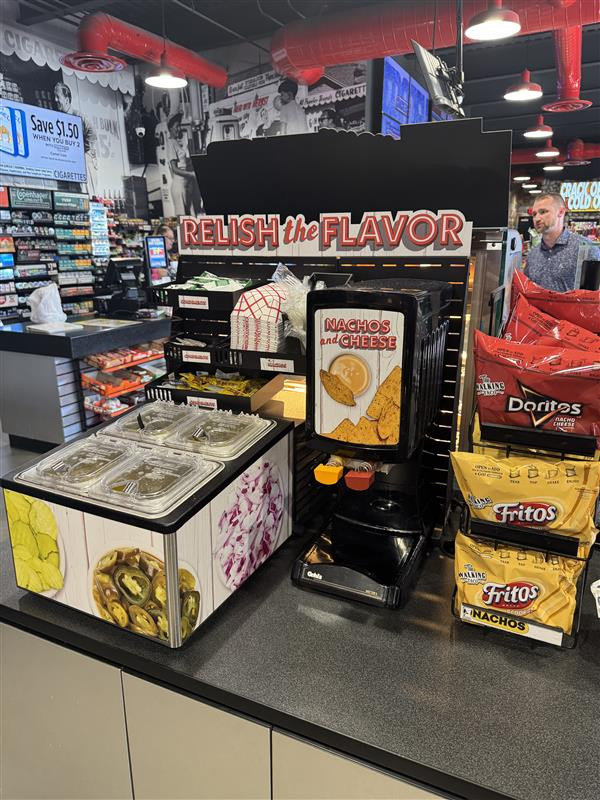
They see a hot food item.
They notice chips next to it.
They see toppings within reach.
That is not accidental. That is designed.
Strong merchandising creates natural add-on behavior without requiring additional effort from staff or customers.
When foodservice is organized, visible, and easy to navigate, engagement increases and ticket size follows.
This is where well-designed foodservice merchandising systems begin to make a measurable difference:
The Stores That Win Design for Visibility
High-performing stores do not rely on chance.
They build environments that are:
- Clear and easy to understand at a glance
- Consistent across locations
- Designed to support fast decision-making
- Structured to highlight high-margin opportunities
They are not adding more complexity. They are removing friction.
They treat foodservice as a system, not a collection of parts.
That is what allows them to scale performance instead of chasing it.
Visibility Is Not a Detail, It Is the Strategy
The gap in foodservice performance is not about demand.
Customers are already there. The opportunity already exists.
The difference is whether the environment supports that opportunity.
More products will not fix it.
More signage will not fix it.
Clear, visible, and well-organized execution will.
Because in a convenience store, sales are not won at the register.
They are won the moment a customer sees something and decides, without hesitation, to take it.