
Adding hot food to a convenience store is one thing.
Keeping it visible, accessible and ready when customers want it is another.
Commercial Hot Food Equipment can support grab-and-go programs, packaged sandwiches, pizza, burritos, pastries and other prepared foods. But the right setup depends on more than how much food fits inside.
Operators also need to think about how customers shop the station, how employees replenish it, how quickly product turns and how much counter space the program can reasonably use.
If you already know hot holding or merchandising belongs in your foodservice program, this guide can help you narrow down which type makes sense for your store.
If you are still deciding what equipment your overall program needs, start with our C-Store Foodservice Equipment Buying Guide.
Start With the Food, Not the Warmer
Before comparing equipment, define what the warmer needs to do.
Ask:
- What products will be held?
- Will they be wrapped, boxed or served another way?
- How long are they expected to remain in the unit?
- How quickly does product sell during peak periods?
- Will customers serve themselves?
- Will employees load the unit from behind the counter?
- Does the menu stay consistent throughout the day?
A convenience store selling packaged breakfast sandwiches may need a very different setup from a store merchandising whole pizzas or a larger assortment of grab-and-go foods.
The equipment should support the menu and the way the store operates.
Enclosed Cabinet or Open Merchandiser?
One of the first decisions is whether the program works better with an enclosed warming cabinet or a more open heated merchandising format.
Enclosed warming cabinets
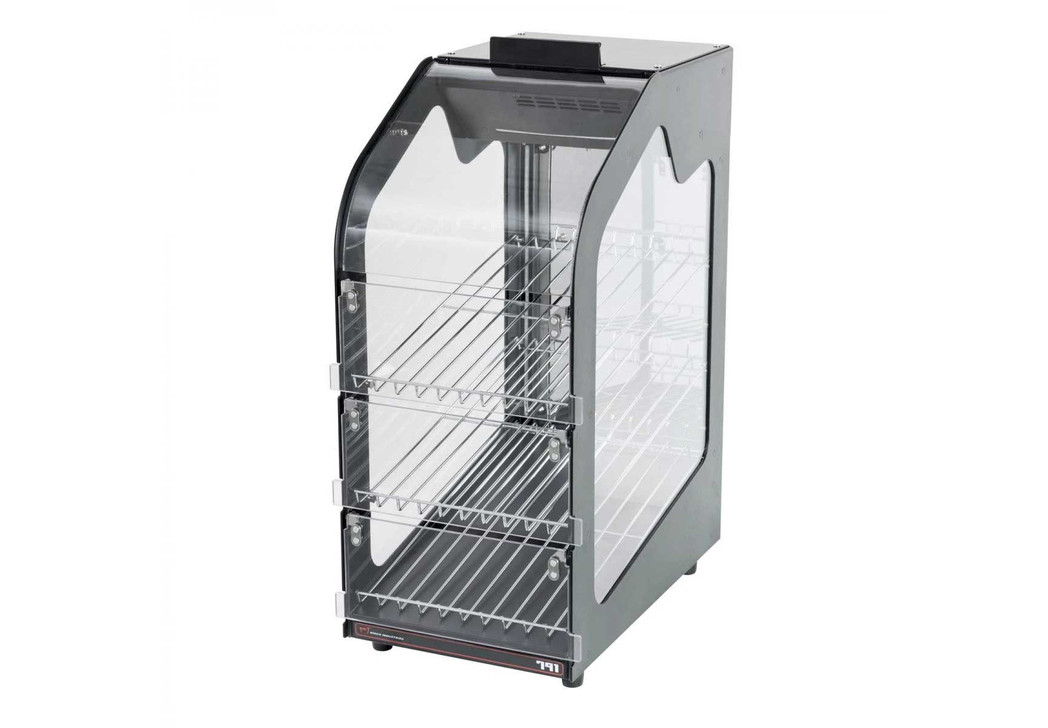
Enclosed cabinets can work well when operators want to hold several products in a compact, controlled display.
Some models provide rear employee access with separate front customer doors. That can make it easier for employees to replenish from one side while customers retrieve products from the other.
FOODPROS currently carries compact models such as the Wisco 791 Slimline Warming Merchandiser, which uses a narrow 9.5-inch-wide footprint, as well as larger cabinet formats such as the Wisco 891. Both are designed around rear stocking and front customer access.
Enclosed cabinets may be worth considering when:
- counter space is limited
- several products need to be displayed vertically
- employees need separate stocking access
- the store wants a defined self-service destination
- product visibility and menu identification are important
Open heated merchandisers
An open heated display creates a different customer experience.
Products are immediately visible and accessible, making this format useful for fast grab-and-go purchases.
The Wisco 282-24, for example, uses a heated shelf and base with an illuminated display and built-in channels for promotional graphics. FOODPROS also carries the Hatco Glo-Ray slanted shelf merchandiser, which is intended for short-term holding of wrapped or boxed hot foods.
Open formats may make sense when:
- speed of purchase is important
- products are packaged for immediate grab-and-go
- high visibility is a priority
- product turns relatively quickly
- the warmer is part of an impulse merchandising zone
Neither format is automatically better.
The right choice depends on the food, traffic pattern and how customers interact with the station.
Think About Customer Access and Employee Replenishment Together
A hot food station has to work from both sides.
Customers need to see the product, understand what is available and retrieve it without creating congestion.
Employees need to replenish the display, monitor product and clean the equipment without constantly interfering with the customer path.
That is why door configuration matters.
A traditional single-access cabinet may be appropriate in some locations. A pass-through format may work better when employees can stock the unit from the service side while customers shop from the opposite side.
Before choosing a warmer, picture the actual replenishment process during the busiest part of the day.
Where will the employee stand?
Where will customers stand?
Where does incoming product go?
A few inches of equipment difference can have a much larger effect on workflow once the store is busy.
Match Capacity to Product Turnover
More capacity is not always better.
An oversized merchandiser uses valuable counter space and may encourage operators to load more product than the store can realistically sell.
An undersized warmer creates a different problem. Employees may spend the busiest periods constantly replenishing it.
Look at:
- peak-hour sales
- number of products offered
- replenishment frequency
- available counter space
- number of shelves or display positions
- how quickly food moves through the unit
A smaller store or developing program may benefit from a compact warmer that can be replenished frequently.
A higher-volume location may need greater display capacity or multiple merchandising zones.
The goal is to match the equipment to real demand, not simply buy the largest cabinet that fits.
Pizza May Need Its Own Merchandising Strategy
Pizza creates a different set of considerations than individually wrapped grab-and-go foods.
Whole pizzas require enough interior space and a display format that keeps the product visible.
FOODPROS currently carries pizza-specific equipment such as the Wisco 695D Pizza Merchandising Warmer, which can accommodate pizzas up to 16 inches and offers rotating or adjustable shelving.
For a pizza program, consider:
- whole pizza versus individual slices
- expected turnover
- shelf or rack dimensions
- product visibility
- humidity or holding requirements
- loading and cleaning access
- how pizza merchandising connects to the rest of the foodservice station
A general-purpose warmer may work for some menus. A dedicated pizza merchandiser may make more sense when pizza is a meaningful part of the program.
Do Not Ignore the Footprint
Counter space inside a convenience store has to earn its keep.
Look beyond the width listed on the product page.
Consider:
- equipment width and depth
- door swing or access area
- space needed for replenishment
- nearby packaging and utensils
- condiment placement
- customer circulation
- adjacent cooking equipment
- electrical access
A narrow vertical cabinet may provide more merchandising capacity without using as much counter width.
An open shelf may require more horizontal space but provide stronger visibility and easier product access.
The right decision depends on what the rest of the station needs to accomplish.
Merchandising Matters Too
Hot food equipment is not only holding equipment.
It is also part of the selling environment.
Lighting, product visibility, graphics, menu strips and signage can help customers understand the offer quickly.
Several FOODPROS warming cabinets include areas for header cards, menu strips or other graphics, while the Wisco 282-24 includes channels designed for promotional messaging.
Think about:
- Can customers clearly see the food?
- Can they tell different products apart?
- Is pricing easy to understand?
- Can promotions change without rebuilding the station?
- Does the equipment support the store's branding?
Especially in self-service foodservice, the equipment often has to do some of the selling.
Check Electrical Requirements Before You Buy
Do not wait until installation day to determine whether a location can support the equipment.
Commercial warming equipment varies considerably in electrical demand.
For example, units currently sold by FOODPROS range from compact cabinets drawing 670 watts to larger heated merchandisers drawing 1,500 watts.
Before ordering, verify:
- voltage
- amperage
- wattage
- plug configuration
- available circuits
- what other equipment shares the station
Always follow the manufacturer's installation and operating requirements.
Consider Cleaning and Daily Access
A warmer may look great when it is full and freshly stocked.
The better test is what happens at the end of the shift.
Look at how employees access:
- shelves and racks
- doors and panels
- interior surfaces
- heated surfaces
- removable components
- areas where crumbs or spills may collect
Some equipment includes removable components specifically to make routine cleaning easier.
If employees have to fight the equipment every time they clean or replenish it, that friction becomes part of the daily operation.
Think Beyond the First Location
For multi-location operators, choosing a warmer is also a standardization decision.
Ask:
- Can the same equipment work in different footprints?
- Is the electrical requirement realistic across the store base?
- Are replacement parts and documentation available?
- Can graphics or merchandising be standardized?
- Can employees be trained on the same setup?
- What are normal lead times?
Consistency can simplify purchasing, training, merchandising and maintenance across multiple stores.
But standardization works best when the equipment is chosen around the operation first.
Quick C-Store Hot Food Warmer Checklist
Before buying a hot food warmer or merchandiser, make sure you can answer:
- What food are we holding?
- How will it be packaged?
- How much product sells during peak periods?
- How often will employees replenish it?
- Will customers serve themselves?
- Do we need front access, rear access or pass-through access?
- How much counter space is available?
- Do we need an enclosed cabinet or open display?
- Is pizza or another specific product driving the program?
- How important are graphics and product visibility?
- What electrical service is available?
- How will employees clean the equipment?
- Does this need to be standardized across multiple stores?
Answer those questions before comparing individual models and the buying decision becomes much easier.
Choose the Warmer Around the Program
The best hot food merchandiser is not necessarily the largest, most expensive or most feature-rich option.
It is the one that fits the food, the traffic, the footprint and the people who have to operate it every day.
A compact warming cabinet may be exactly right for a smaller grab-and-go program.
A larger enclosed merchandiser may support more variety and higher volume.
An open heated shelf may make sense when visibility and quick customer access are the priorities.
And a dedicated pizza warmer may be the better choice when pizza is a significant part of the offer.
Shop Commercial Hot Food Equipment from FOODPROS, or contact our team if you need help narrowing down the right equipment for your operation.
FAQs
What type of food warmer is best for a convenience store?
The best type depends on the menu, sales volume, available space and how customers access the food. Enclosed warming cabinets can support multiple products in a compact footprint, while open heated merchandisers can make packaged grab-and-go food easier to see and retrieve.
What is the difference between a food warmer and a heated merchandiser?
Both can help maintain hot food for service, but a merchandiser places additional emphasis on product presentation and customer access. Features may include lighting, graphics, open shelving or customer-facing doors.
Should a convenience store use an open or enclosed hot food merchandiser?
An open merchandiser can work well for fast-moving packaged foods and easy self-service. An enclosed cabinet may provide more controlled access and can offer multiple shelves in a relatively compact footprint.
How do I determine what size food warmer I need?
Look at peak-period sales, the number of products offered, how frequently employees can replenish the unit and the available counter space. Capacity should support busy periods without taking more space than the program requires.
Can hot food warmers be customized with graphics?
Some warming and merchandising equipment supports header cards, menu strips or graphic channels. Available customization depends on the specific equipment.